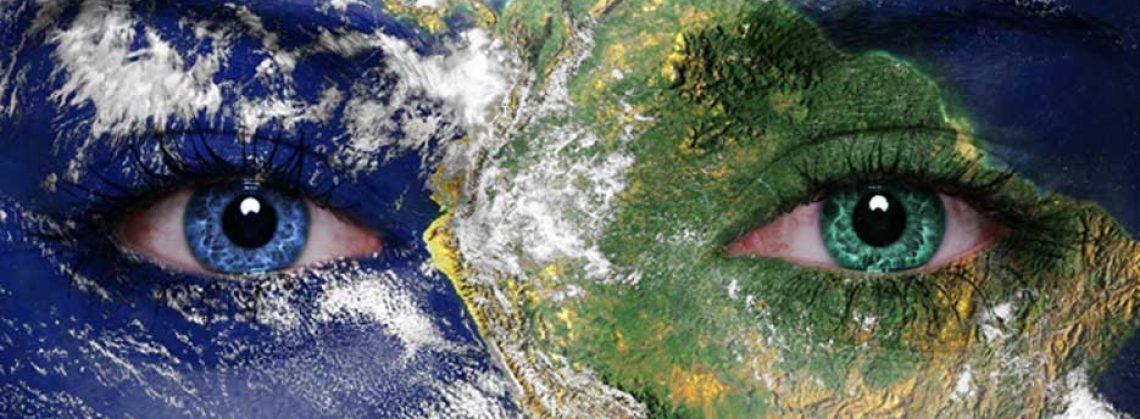
A Positive Psychology Reset for an Ecological Future

“Psyche and Physics can no longer be kept apart.”
(Inspired by Carl Jung’s collaboration with Wolfgang Pauli)
SYNPOSIS: The climate crisis poses a pointed challenge to Western psychology, hobbled by its stubborn clinging to the Cartesian, scientific materialist worldview that gave birth to Western science, the medical model adopted by Western psychology, and the climate/biodiversity crisis itself. This dominant worldview is called into question by the ongoing quantum paradigm shift, it is at odds with Indigenous wisdom, and it supports the ongoing exploitation of the natural world. Given the existential dimension of the current meta-crisis, it is incumbent on those professions most responsible for promoting good mental health to become much more proactive and prescriptive in addressing the collective pathology grounded in the objectification of self, others and nature. Such a ‘radical’ reorientation requires the promotion of a positive psychology, rather than simply applying psychological triage to the symptoms of climate trauma. Such a positive psychology should be well-suited to bringing about the kinds of quantum leaps in social attitudes, civic relationships, and personal lifestyles that are going to be needed for humanity to become more resilient, naturally coherent and, ultimately, regenerative. The approach suggested here would have mental health professionals advocate for shared responsibility towards the climate and biosphere and, on that ethical ground, promote a holistic model of cultural indigeneity that would be instructive for individuals, families, and decision-makers. Pursuant to this approach, individuals’ self-regulation is to be viewed as a unique expression of Gaia’s own homeostasis, thus bringing us into relationship with Gaia based on co-regulation. A personal case study illustrates how that praxis can unexpectedly catalyze systemic changes in the ways that post-modern, post-colonial people relate to Indigenous communities and ecosystems, and how this kind of change can reverse global warming by drawing CO2 down from the atmosphere at scale.
__________
“I’m always thinking about peace with Earth rather than peace on Earth because one is held in domination and one is held in relationship.”
~ Lakota Educator Tiokasin Ghosthorse ~
_________
The Existential Dimension of the Human Problem
The myth of modernity is a dead end. The myth of materialism, which objectifies everything from children to food, is killing us. Life as we have always known it during the 11,000 year Holocene era of a relatively stable climate is over.
What we sorely need now is a new myth, one that is congruent with Nature, and grounded in human nature. And the psychology community- which is still largely tied to the scientific materialist (Cartesian), objectivist worldview of self-in-here, world-out-there, the very worldview that got us all into this mess – bears the lion’s share of responsibility for addressing our collective pathologies and pointing the way toward a more humane, ecological civilization.
This conspicuous absence of any galvanizing vision of a post-modern, ecological citizen of the world was recognized by Pope Francis in his radical encyclical Laudato Si, in which he poses the question “what does it mean to be human?” in light of the existential threat to all life on Earth presently posed by the climate and biodiversity crises.
What does it mean to be human in the Anthropocene?
This near-total absence of an alternative to modernity lends itself to ridicule and marginalization from the materialist defenders of the status quo when they suggest that climate activists would have us all return to living in caves. Nothing could be further from the truth, of course, than characterizing ecological civilization as primitive or backwards thinking. It is, instead, quite simply a life-affirming civilization that we are talking about here.
What is actually needed at this pivotal point in human evolution is not just a new myth, but a new worldview that displaces the life-denying materialist worldview. A worldview that includes a new model of self, a new mode of post-modern sensibility that is well-suited to – and salutary within the context of – this climate-challenged world. From this new worldview and congruent model of an ecological self, a new myth will arise naturally. What this requires from the field of psychology is a relational model of the modern climate-conscious citizen that conforms to the demands of survival while empowering, and not demeaning or demoralizing, the individual.
To those psychologists who would object to this task as the role of philosophy, not psychology, I would simply remind you that psychology began as “psychologism,” a branch of philosophy where many of our founders, including William James, believed it should have remained. Instead, we ended up with a medical model of psychology focused on treating symptoms, not diseases, giving rise to Big Pharma and, I would argue, the unabated collective pathologies that make it so difficult for us to address the life-and-death consequences of capitalism and our consumer culture.
Almost everyone would agree that we are in the midst of a global mental health emergency. As Stanislav Grof, one of the leading contemporary thinkers about the human psyche, has shown, with proper support any psychological emergency can result in the emergence of something new just waiting to be born. That is the principle that underlies Planetary Hospice; that is, we are in the midst of a kind of planetary initiation that will, in time, re-birth planet Earth and transmute the human species – by necessity, if not by choice. This calls for moral leadership from the global community of psychologists, with or without institutional support.
If climate scientists find it necessary to become political in response to the moral dimensions of our existential crisis, how in the world could psychiatrists and psychologists justify sitting silently by as our collective pathology plays out in the most unnaturally destructive ways on the world stage?
Fortunately, the APA at least has finally ‘found religion’ on this point, issuing a clarion call in 2022 to all psychologists to get more politically active and bring their unique expertise to bear in constructive ways at the local and cultural levels of society. See, e.g.: Addressing the Climate Crisis An Action Plan for Psychologists . Similarly, “Climate Psychology Alliance(s)” have sprung up sua sponte in the U.K and North America over the last decade or so, and are gaining more prominence.
This is a good start, but it is at this point still more representative of a reactive posture rather than a proactive movement. Given the levels of mental distress, especially among the young, that is understandable triage. It was important to prevent mainstream psychology from medicalizing climate anxiety and distress, which are natural human responses to climate trauma. But to be proactive requires psychology as a whole to agree upon a promising new framework for promoting mental well being, in light of all we’ve learned over the last century-plus, combined with what we know will be needed to meet this unique moment in our evolution as a species.
If that sounds daunting, it shouldn’t. Our worldview is already shifting, and people are hungry for meaningful change. In an era of global interconnection and heightened chaos, small catalysts have the potential to effect great leaps forward in public understanding and societal change. But we must be more intentional about the direction of those changes.
A “Quantum Paradigm Shift” in worldview has actually been underway for nearly a century now, and it holds all the necessary clues to spur a “quantum leap” in how we humans collectively see the world during this time of growing peril. Fortunately, I’m not the only one to think so. As former IPCC member and social scientist Karen O’Brien, from the Univ. of Oslo, clearly and eloquently explores in her writing and thinking, if we intentionally substitute quantum thinking for older, established Newtonian ways of thinking about things, we come to realize that our own actions matter a lot more than we tend to think they do. This, in turn, points to untapped potentials for massive changes on the human side of the climate equation.
At its root, quantum thinking represents a profound shift from the atomistic, mechanistic, reductionist, and individualistic perspective of colonial exploitation and the various egoic ways of thinking that have dominated culture and society ever since Rene Descartes wrongly proclaimed: “I think, therefore I am.” This shift towards relational thinking better reflects the interdependent and interpenetrating world we actually inhabit.
Relational thinking is anathema to othering, objectifying, exploiting, and monetizing living beings – up to and including the living planet we are integral parts of. What is emerging in contrast to the outdated materialist worldview is a much more relational and participatory perspective, a more ‘wholesome’ worldview that belatedly honors the wisdom and “Traditional Ecological Knowledge” of Indigenous peoples and cultures everywhere in the world.
In fact, by the global consensus of the International Panel of Climate Change scientists and the United Nations as well:
“With only a limited window of time to bend the emissions curve, adapting to changing climate conditions, and halt the rapid decline in biodiversity, the values and wisdom of indigenous peoples can help societies achieve this transformation.”
The cutting edge of solutions to our poly-crisis employs “two-eyed seeing” that embeds Western science within the framework of the “Traditional Ecological Knowledge” from Indigenous wisdom perspectives – two very different, but ultimately reconcilable, ways of seeing the world. Over 80% of the worlds’ remaining biodiversity is located on lands inhabited and controlled by Indigenous people. Culturally and ecologically speaking, they are our elders.
To be perfectly clear, the reason for this ongoing paradigm shift is that quantum physics blew Cartesian dualism and scientific objectivity (materialism) right out of the water, though our thinking is slow to catch up. From Academia to journalism, we still cling professionally to “objectivity” for maintaining credibility, and this kind of thinking colors our separatist thinking about the climate and biodiversity crises as well, as even these are but two sides of the same crisis. Fortunately, it is not necessary to study math and achieve a deep understanding of quantum physics in order to adopt the emergent, relational worldview.
The shocking takeaway from quantum physics, as we learn from physicists like Trinh Xuan Thuan and Laurent Nottale, is that there are no such things as “objects” in the world! What we think of as solid objects (e.g., ‘tree’ ‘rock’ ‘person’) are mere labels that we attach to phenomena (usually motivated by the need to assess, possess, and control those phenomena). But solid objects are neither solid nor objective. When we break what appears to us as matter down to its smallest bits, or quanta, we don’t find any bits at all. Instead, what we discover are waves of potentiality existing in fields of resonance that collapse into particle-like phenomena only under the influence of an observer’s consciousness.
Let that sink in. That anomalous reality is the seed that eventually sprouts quantum awareness in our mind. There is no separation between self and other. “Reality” is spontaneous and reactive, not objective and neutral. Mind turns out to be quite powerful in the mix! Our psyche is vast and, as Jung and Pauli observed, entangled with the physical world. Consciousness is an ocean of astonishing breadth and depth, and it’s tidal force penetrates and shapes the physical world.
Let us unpack this now, because it will lead quite naturally to a new model of the post-modern self – an interconnected, ecological self, integral to Earth.
Scientific Objectivism vs. Quantum Relationality
Descartes and Bacon provided the foundation for Western science by asserting that we can objectively observe the world, because as creatures of thought we humans are ultimately separate from it and all its other inhabitants. Then physicists discovered that in the realm of quanta, or matter, there really is no way to separate the mind of the experimenter from the results of the experiment. No such thing, in other words, as objectivity. You can see how integral something like a belief in objects and objectivity might be to our world view – and how it could create big problems as well.
This shocking discovery by quantum physicists stands scientific materialism on its head, and has profound implications for the human psyche as well – something only Carl Jung, who worked closely with physicist Wolfgang Pauli, seemed to grasp at the time (ironically, this caused him to be dismissed as a mystic!). Working together to solve the mystery of synchronicity, Pauli & Jung came to the most remarkable conclusion – one that should have stood psychology on its head – that reality is psycho-physical through-and-through.
A big part of the meta-crisis we face today is that Western psychology has not corrected itself for the emerging quantum world view. For example, it still fetishizes so-called “objective empiricism” to the exclusion of the “subjective empiricism” that has been developed and refined over thousands of years in Buddhist psychology. From the standpoint of quantum awareness and quantum thinking, this stubbornness of Western materialist thinking reminds me of what my hot-house yoga teacher used to say at the beginning of every class: “This practice is a matter of mind over matter. What’s the matter? The mind!”
Simply stated, there is no such thing as objectivity.
Objectivist thinking is dead. The materialism of scientific-materialism is a myth. Reality can not be observed apart from the observer. The significance of this quantum weirdness could not be more relevant to our meta-crisis and our existential angst. As physicist Laurent Nottale puts it:
“If things do not exist in absolute terms, but do nevertheless exist, then their [true] nature must be sought in the relationships that bring them together. Objects are relationships.”
A helpful way, then, of restating the Jung/Pauli principle is this: the world we live in is relational through and through. Accordingly, every crisis, up to and especially including the climate crisis, is a crisis of relationship. I can guarantee you that any Indigenous person you talk to will agree with this proposition. They know better than any of us what it is like to be objectified as a race of people and then othered into oblivion by that way of thinking.
This relational worldview stands in stark contrast to the scientific materialist view that still prevails today, especially in academic and journalistic circles, which sees the climate crisis as some kind of grand experiment gone wrong, and which looks to the parameters of the experiment itself for solutions – as if humanity is Dr. Frankenstein or God fiddling around with nature and technology dials. This is the worldview of global weirding that we can trace back to Trinity and Hiroshima, when then U.S. President Harry Truman proclaimed that we humans now controlled the basic powers of the universe, and psychologically back to the Discovery Doctrine, when Pope Alexander VI issued a Papal Bull (1493 A.D.) declaring the world’s Indigenous people as lower than human – primitive savages to be extirpated from the mineral-laden lands they inhabited.
Like Pope Alexander, Descartes and Harry Truman were both dead wrong. In fact, the entire colonialist mindset was wrong from the start. Descartes posited that there is a fixed “I” in here, and a mechanistic world out there, based on his religious view that “mankind” – by which he meant white Europeans – was privileged by God over all of his creation (even though he threw us out of the Garden, Rene?).
This view was formalized in the Papal Bull, providing religious sanction and moral authority for Europeans to subject Indigenous people to slavery, slaughter, and dispossession. Religious genocide! So that we could steal their lands.
We now refer to this as “othering,” which Descartes himself regularly demonstrated with live vivisection of animals in the public square, meant to ‘prove’ that animals were not sentient beings. It is not a big step from animal torture to public lynchings, or from industrial civilization to industrial warfare and human killing factories.
To this day, we can still see how the world’s worst conflicts and most toxic social movements are empowered by “objectifying” other human beings as “less than” divinely favored (“reified”) individuals – from the MidEast (“cockroaches”) to Ukraine (“Nazis”), and as on full display at MAGA rallies where a mentally unhinged demagogue elicits raucous cheers from the hoi poloi by proclaiming immigrants are “not human” and black prosecutors are “animals.” This is the very logic of the death spiral we need to pull ourselves out of before it’s too late, and it is the also the logical culmination of scientific objectivism let loose on the world like a deadly thought virus turning humans into mindless zombies.
That is the malignant narcissistic pathology that is destroying the world. It would behoove the American Psychology/Psychiatry Association to take a position on it. Because at its poisonous root, it is nothing more than the product of a cultural overload of accumulated, unresolved trauma associated with othering and objectifying, two sides of the same coin, where perpetrators like Trump and Netanyahu pose as victims, and victims from the past become the perpetrators of today.
The whole natural world is caught up in the vicious vortex of this death spiral, the dissonant crescendo of the so-called modern world of consumption and destruction. It is not enough, when participants in this deadly paradigm present themselves in therapy, to make them feel less unhappy about their lifestyle, as Freud maintained, or to help them rationalize their complicity in the destruction of the natural world.
There is a name for that tone-deaf practice: Industrial Psychology. I was actually forced to take that class in engineering school, which was intended to help me see humans as widgets! It is monetization at its very worst. And Environmental Psychology is similarly toxic – how to manipulate people’s environment in order to make them better consumers. In fact, Freud’s cynical depth psychology was initially championed here in the U.S., after not really taking hold in Europe, by his nephew Edward Bernais, an industrialist who saw great potential in exploiting people’s desires, and the inventor of “public relations.” And let us not forget that, more recently, psychologists carrying the imprimatur of the APA went so far as to advise the Bush Administration on the art of torture!
Please don’t get me wrong – there are plenty of good psychologists in the world today, many of whom I happily collaborate with. It is the institutions of psychology and psychiatry that have been morally compromised. The way they do business and the manner in which they engage/interface with the culture-at-large – in contrast with morally activated climate scientists, for example – need to quickly be reformed in life-sustaining ways.
Perhaps the APA Climate Task Force can expand its role and become a driving force for reformation. They seem equipped to do this, if not exactly empowered. A fierce urgency is what the existential character of the meta-crisis demands from us all. (Note: “poly-crisis” denotes the climate/biodiversity/plastics aspects of our existential crisis, while “meta-crisis” brings in the philosophical and psychological aspects of our mental health crisis).
The Climate Psychology Movement
Responding to the moral implications of what they know and how they see their role in society, hundreds if not thousands of psychologists around the world have banded together and created a kind of shadow APA, collectively organizing and activating under the banner of “Climate Psychology Alliance” (UK/Europe and North America). This has been an encouraging development, as the relational antidote to all the cultural pathology, institutional negligence, and individual complicity underpinning our inertia is to actively promote a communal sense of shared responsibility for both the climate and for the colonialism that has recklessly destabilized it. We the privileged beneficiaries of colonialism must be willing to acknowledge the grievous consequences of our society’s past actions (encouraged if not sanctioned by the institutions of our culture) if we are to make the critically necessary changes in the way we relate to ourselves, to others, and to the world at large.
This kind of relational thinking is reactively reflected in social movements that are intentionally changing the way we interact with one another (e.g., MeToo, BLM, DEI, Indigenous Rising/Land Back, etc.), in the persistent calls for equity between the Global North and the Global South and island states and, more proactively, in the new science and thinking being spurred by Gaia theory. When we embrace the still emerging quantum worldview, and then synthesize that perspective with the more recently emergent Gaia paradigm, and when we then work hand-in-hand with Indigenous science and wisdom traditions, the long-term solution to global weirding suddenly becomes both apparent and plausible. As we will explore here later, Nature is the answer to our crises, and human nature is a big part of that.
Western/industrialized psychology, regrettably, remains largely focused on servicing the ego and reinforcing individualism, while psychiatry has been captured by mechanistic/reductionist thinking (DSM) that primarily serves the interests of the pharmaceutical industry. Big Pharma and psychiatrists are complicit in suppressing social dissonance by medicating the masses to accept a kind of “Brave New World”; first, with anti-depressants; then, opioids; and next, it’ll probably be anti-psychotics. Whatever works to numb the spirit.
The only thing more prevalent in America than guns are pills!
Acknowledging the mental health pandemic this (not so) brave new world has spawned begins not with taking advantage of people’s misery and spiritual angst for private gain, but rather with recognizing that spiritual angst and mental anxiety up to and including depression/demoralization are natural expressions of a negative feedback loop with the larger living organism we are both an integral part of and, incongruously, actively destroying.
How could we NOT have a mental health crisis under these circumstances?! And how is it not the responsibility of the mental health professions to call it out and conjure up a mental health remedy that will reverse these fatal trends?
I am not the first to make this observation, of course, and so here is an important point in that regard:
While eco-psychology was intended as a corrective measure to the inherent pathology of Western psychology, intentionally replacing “ego” with “eco” (home, or Nature) at the center of self, it has largely failed to move the needle of social pathology since its founding more than three decades ago. We’re still grievously wounding our life source in the pursuit of selfish and self-privileged aims. And we’re still exploiting the Global South as if it is our privileged birthright. Not surprising, as Indigenous voices were largely ignored at the very inception of eco-psychology by mostly white males (in spite of the best efforts of tribal representatives like Dr. Leslie Gray). What is sorely needed now is a new model of self that incorporates a set of ideals and values that are congruent with Indigenous wisdom (i.e., human nature) and have the inherent potential to act as a catalyst of quantum social change towards an ecological civilization where humans are a keystone species for trophic upgrading, not a voracious species spreading trophic downgrading.
One rather modest proposal out there that reflects this kind of psyche-shifting potential is Dr. Dan Siegel’s re-definition of the self as “me + we = Mwe.” We are a linguistic species, after all, and the power of words to transform our relations with Nature has been beautifully illustrated in Dr. Robin Wall Kimmerer’s book, Braiding Sweetgrass: Indigenous Wisdom, Scientific Knowledge and the Teachings of Plants (2015). I’ve already alluded to Dr. Karen O’Brien’s brilliant contribution to this shape-shifting effort as well.
But speaking now as someone who has been researching, writing, and thinking about these issues ever since I left the floundering climate movement in 2011 to study our pathology in a more systemic way, and whose proposed new taxonomy of traumatology has now been sanctioned by the APA itself, I’ve come to the conclusion that what is sorely needed from the mental health community going forward is a reformist-oriented “positive” psychology that will support a thriving human ecological regeneration.
For too long now, indeed from its very inception, psychology has been focused on pathology and the treatment of symptoms presented by those suffering from what qualifies in any given era as mental illness. And there is a (not good) reason for this – that’s where the money is: Psychological Complex + Rx = $$Big Pharma. Big Pharma funds the studies in Academia, thus closing the negative feedback loop. Nobody gets funding from Big Pharma to study psychological well being!! Doesn’t that seem like a rather significant omission by our profession?
So the development of psychology over the first century or so has been stunted. There is not much to point to when it comes to what we call “positive psychology.” One of the few exceptions worth noting is studies of the generative “flow” state by the man with the unpronounceable name: Mihaly Csikszentmihalyi. Another more recent example that comes to mind is Gretchen Rubin’s “The Happiness Project,” which grew out of her best-selling book about taking a year out of her life to focus on her own mental well being.
But these are outliers in the field of psychology. They’re not really suited to the kinds of collective pathologies we see playing out in the world right now. There is every reason at this crucial juncture in human history for the field of psychology to offer much more, by recognizing the relational nature of both our crises and their solutions, and by promoting a positivist psychological framework for resolving our differences and coming into proper relationship with ourselves, our others, and our planet. Indeed, one could characterize the urgency of this effort as a kind of Manhattan Project for the human psyche.
I find myself in agreement with many social and climate activists, and many of the movers and shakers in the climate psychology movement, that the self-centered settlor attitudes we all, or most of us anyway, share represent a major obstacle that needs to be overcome if we are collectively to come into proper relationship with the natural world in time to salvage a biodiverse, viable future for our children’s children. Just look at the clear and present dangers posed by self-centered, toxic male authoritarian movements here in the U.S. and other nations in the Global North who are now dealing with waves of climate refugees, which were predicted as a result of climate change as far back as 2008 by the International Energy Agency. We need to take this global threat from the more primitive human psyche on honestly and forthrightly – not by sane-washing it or pretending that it is anything other than what it is: racist and fascist to the core.
We’ve seen it all before, right? It is a form of psychological mind control and manipulation of the masses that leads to widespread mass mortality and a world at war, and do it deserves a life-affirming response from global psychiatrists, psychologists, and mental health professionals. This is no time to stand by silently or offer pithy critiques. In fact, this is precisely where positive psychology comes in. It is one thing to define and call out social and cultural pathology. It is quite another to offer up and promote a model of psychological well-being. Without the latter, the former seems to keep popping up like history’s whack-a-mole project.
If we are to survive as a species, we need to eradicate this collective pathology, to cure and to heal it once and for all. Literally, for a future to be possible that includes us.
Towards a Holistic Model of the Human Psyche
“The universe rests on relationship.”
~ Brian Swimme, Cosmogenisis (2022)
It is important to point out at the outset, so as to avoid charges of cultural appropriation, that I’ve developed my own ideas along these lines in a “two-eyed” way; that is, by keeping one foot in the academic world of social psychology and philosophy, while at the same time finding my footing in the more promising and emerging world of Indigenous-led climate solutions. In other words, the ideas that I present here have been “truth-checked” with Indigenous healers, long-time Tribal friends of mine, as well as with at least one of the Indigenous thinkers who felt marginalized and dismissed at the beginnings of the ecopsychology movement.
In other words, these ideas and conclusions from my academic journey have now been ground-truthed in the real world of ecological trauma and recovery, in alliance with wise Indigenous leaders promoting Traditional Ecological Knowledge and lifeways. That invaluable, informative feedback loop leads me now to suggest that the approach I outline below does, in fact, hold the potential to catalyze the kind of quantum social change that would actually reverse global warming over a course of decades. Paradigm change does not happen overnight, after all. This approach is both relational and science-based, being informed by Gaia theory and quantum physics. It is also instructive, in that there is a role for each one of us to play in changing the relationship between humans and the natural world. It is empowering, because anyone can tap into Gaia’s positive psycho-physical feedback loops. All of which I will set forth here.
This positive Gaia-psychology is, in summary, emergent, ground-truthed, and actionable.
Part of the ongoing quantum paradigm shift in the world today, spurred by the advent of the world wide web and reinforced by the climate crisis, is the now prevailing view of interdependence. So while it is true that we need a new way of thinking about our ‘selves’ in an increasingly interdependent and interconnected world, I’m not convinced that this alone can serve as the quantum catalyst. I would suggest that most people in the West, where the existential threats are emanating from, have an identity that is far more wrapped up with global consumerism and cultural modernity than with that archaic, rugged individualism of the old West.
Furthermore, it is the global consumer lifestyle itself that is rendering them compliant, overwhelmed, and powerless to change the world. It’s a bad kind of interdependence reinforced by lowest-denominator social media. This is exactly how climate and/or biospheric trauma manifests in a dissociated culture. Call it the banality of consumerism. Since there is someone else to blame for my feelings of dread, anxiety and depression, and since there are pills to help me eliminate the symptoms of having a conscience in a dying world, I’m going to tune all that out and just enjoy the balmy weather.
What alternatives have we been given? What is the choice if one sees the need to reduce their complicity or to decouple their lifestyle from the heat-engine of the global economy in response to their children’s persistent pleas?
This is precisely where psychology has let us down. Other than becoming vegan and buying an electric vehicle, there’s really no model for how to be a climate-conscious human being. And while it may seem great to have a life coach or a neurologist instead of a therapist, shouldn’t there still be some over-arching vision of how changed behaviors fit into a post-modern world that serves life?
What is that vision? If it’s just people with electric cars driven by artificial intelligence, if it’s just the continuation of exploitation by social media under a different name, be it “Meta” or MAGA” or, for that matter, “Quanta” — it is not going to cut it!
Before proposing such a model, let me briefly explain how it can be considered salutary. We can’t lose sight of our survival objective here.
Returning to our quantum premise that the climate crisis is a crisis of relationship, we must acknowledged that ultimately, humanity must restore a proper relationship with the natural world. That can only happen bioregion-by-bioregion, and ecosystem-by-ecosystem, with humans seeing themselves as integral parts of nature, not separate and apart from nature.

The science behind this is encapsulated in E.O. Wilson’s “half-Earth” proposal, which demonstrates that if we shore up the third of all marine and terrestrial ecosystems that are still functioning by, say, 2030 (the 30/30 initiative adopted by most nations in the Global North), and then continue to increase that functionality all the way up to 50%, or half the Earth, through regenerative agriculture, working with Indigenous people, rewilding, and supporting about 20 climate keystone species, by say 2050 (the 50/50 proposal), then we will trigger a reversal of global warming by drawing down far more CO2 than we are presently emitting.
That’s the kind of immensely resilient potential that is latent in nature. That’s why we need to enlist Gaia as our ally in the climate struggle, rather than seeing her as a threat or something to be manipulated and contained. As a popular commercial’s tagline put it: “It’s not nice to fool Mother Nature.”
And when we finally have replaced fossil fuels with renewable energy, hopefully by the middle of the century, the continuing drawdown from regeneration and rewilding will then not just have a mitigating effect, but will instead begin the natural process of returning CO2 levels in the atmosphere to pre-industrial levels that are conducive to life, and we will have reversed global warming. I’m not pretending here that we haven’t already passed some tipping points, such that the oceans will continue to rise, for example. I’m simply stating the obvious: we must find a way to bend the CO2 curve back down. That is the essence of the One Earth Climate Model depicted in the above graph.
Now, as this has become a matter of some controversy, it is necessary to be very clear that when Wilson published his proposal back in 2016, human development and meddling was only associated with trophic downgrading. Thus, Wilson, while a brilliant scientist, had the rather colonialist idea that half the Earth needed to be free of humans. But a whole new science of trophic upgrading, centered on correctly identifying those keystone species who have the potential of producing cascading ecological benefits, has developed since then. In fact, scientists have now identified 20 large-mammal assemblages that are considered to be climate keystone species, because with humans supporting their propagation, we can rather quickly restore the ecosystems they inhabit.
We’re talking wild bison on grasslands, whales in the ocean, and sea otters propagating kelp forests here, all with immense potential for drawing down carbon from the atmosphere. The example that strikes home for me is that if we were just to restore bison, with Tribal leadership, to available (trophically impoverished) grasslands in the Western U.S., we could draw down twice as much carbon as we currently emit — every year! And as we will see, this effort is already underway, thanks to the leadership of Native Americans who head up both the Department of Interior and the National Park Service.
So yes, E.O. Wilson got some things wrong about how to implement his half-Earth proposal. But the science is good, and we have to resist the urge to throw his baby out with his bathwater! I’d wager that if he was still around, he’d agree. Climate science is very fluid, like Nature herself.
So that’s the macro-level of restoring proper relations, right? That’s the vision all of our relations need to become congruent with. It is neither utopian nor dystopian. It is just good Earth systems science that considers energy in context, rather than ceding power to the “fossil fuel until its gone” industry.
Consistent with this Earth science, The Kunming-Montreal Global Biodiversity Framework, an outcome of the 2022 United Nations Biodiversity Conference, was adopted by the 15th Conference of Parties (COP15) to the Convention on Biological Diversity in 2022.It has been hailed as a “huge, historic moment” and a “major win for our planet and for all of humanity.” One of the main goals of the Framework reads as follows, making clear I think that the colonial approach of “pristine wilderness” is a relic of the past:
Biodiversity is sustainably used and managed and nature’s contributions to people, including ecosystem functions and services, are valued, maintained and enhanced, with those currently in decline being restored, supporting the achievement of sustainable development, for the benefit of present and future generations by 2050.
That sounds inclusive to me. This is the way forward – and the basis for a new kind of global solidarity. Of course, it is imperative that it not be hijacked by Big Business, as the Paris Accords have been under the auspices of the Climate Change Conference of Parties, which has been quite demoralizing. But that just emphasizes the need for activists to seize the initiative by promoting Nature as the answer to all of our future problems. We can do this, but the thinking still lags far behind in many respects – which calls for a new psychological container.
The Global Deal for Nature encapsulates this approach, dividing the world into 840 eco-regions, both terrestrial and marine, and proposing fully protection of 30% of the planet by 2030. Another 20% is then to become the focus of climate stabilization efforts between 2030 and 2050 to reduce land-based climate impacts from certain inhabited ecosystems having the highest potential to restore biodiversity. While it is not explicit, it is imperative that these transition efforts piggy-back onto the science of identifying and supporting keystone species, as already alluded to. These areas will be designated as climate recovery zones, and people will be a major focus in these recovery zones. They will be encouraged to change the way they relate to, or live with, their home ecosystems’ flora and fauna, including such simple measures as bringing back beavers to retain badly needed moisture in forests, favoring native forbs and grasses over manicured lawns, and using prairie dogs to restore soils on cow-burned landscapes. There is even approved funding from the G-20 to hire scientists (preferably Indigenous) to lead these efforts in every ecosystem on Earth through education and outreach, specifically targeting a youth corps of “Earth Guardians,” and supporting those who show real promise with scholarships.
As someone who has lived most of his adult life in the West working on public lands protection, I can say without reservation that the success of such efforts will require radical attitudinal shifts, as most of the people in these areas make their living from the land by extracting ‘natural resources’ like forage, forest products, soil productivity, water and minerals. But this Earth Guardian initiative, supporting 50/50, seems to me a very promising beginning along those lines.
In fact, those attitudes are already starting to shift. We no longer think of forests as a collection of “trees,” for example. Gaia theory has given rise to radical new ideas about forest sentient communities, the intelligence of the mycelium network – or ‘wood wide web’ – and the critical role species like beavers, wolves, salmon, and wild bison play in keeping ecosystems vital, or restoring them when they’ve become degraded by unwise and unnatural human exploitation.
As mentioned briefly, we’ve learned that whales have immense potential to sequester CO2 from the atmosphere, burying it in the ocean floor to support new life there, and cutting edge researchers are now within a couple of years of actually being able to open up a line of communications with whales, utilizing machine learning and artificial intelligence. It is fitting that humans first contact with an alien intelligence will end up happening with that Earth-bound species that happens to possess the largest, most complex brain!
We already know, for instance, that whales give one another names, and mother whales sing lullabies to their children! Did you know that elephants communicate with one another over many miles distance utilizing subsonic frequencies that travel underground? The more we learn from inter-species study and contact, the more we find neural networks in forests that mimic our own, even utilizing the same neurotransmitters we find in our brains, the closer we come to making contact with the most complex, highly intelligent organism of all: Gaia.
This is the way forward, even as natural systems are unravelling all around us. It isn’t either/or – it is both, and.
Nature is the Answer.
We have to help people understand that. That is the mantra of regenerating civilization. It is our best hope, if not our only one.
This brings up another problem with consumerist thinking that needs to be accounted for in any new positive psychology. Thanks in large part to our legal system, our notions of personal responsibility have changed dramatically from an idea of shared responsibility, which characterized society during the Great Depression and World War II, to an idea of ‘distributed’ or legal liability, which prevails in consumer society (i.e., my harms are someone else’s fault).
It is more imperative than ever that we promote an ethic of shared responsibility, which is forward looking and participatory (what can I do?), and is best suited to meeting the existential threat of the climate and biodiversity crises. It is this shared land and sea ethic that will prompt all of us, and especially the children whose future is on the line, to learn about the ecosystems we inhabit, and to come together for the purpose of advocating local solutions to global problems. That is the power of shared responsibility for the climate, a position advocated by leading ethicists.
What all of this is pointing to, then, is a new way for non-Indigenous human beings to become indigenous to our world. And that happens to be what Indigenous people are asking of us as well.
“All of us are indigenous members of Earth Community equally – there is no higher placement of a master over another – and it is high time for all of us to become Indigenous again.”
~ Physicist Vandana Shiva ~
You will notice that this framing – “indigenous to our world” – already points to a difference from Indigenous people, whose own indigeneity is defined not by any global sensibility, but rather by the place where their ancestors are buried. Our modern psyches have, by necessity, been drawn into relationship with the entire planet, which even our scientists now acknowledge is alive, and which our best scientists – astronauts – acknowledge is aware, is a conscious being. NASA even has a term for this surprising conversion: The Overview Effect.
Our way of relating to our home ecosystems is being driven by the dysfunctional way we have come to relate to our life source. This is why we need to start our re-orientation from the macro level of climate impacts, from seeing the world the way the astronauts do, and this is why I call this model “holistic indigeneity.”
It is not so much an assertion that traditional indigeneity is not holistic, but rather that it starts from place and is oriented outwards toward the whole, while post-modern indigeneity, beginning with Earth Rise and Lovelock/Margulia’s Gaia Hypothesis (now good theory), is oriented from the outside in – like, from outer space! Because, for some reason, that’s what it took for settler-explorers to finally grasp what Indigenous people never forgot: we are part of a sacred whole, a circle of life that comes with sacred responsibilities.
But promoting holistic indigeneity also has the effect of changing the way we relate to our own ecosystems and bioregions. It’s just backwards-oriented, from the outside in, rather than from the inside out, and that will always distinguish the two ways of seeing the world. That is the essence of “two-eyed seeing.” Ours and our Indigenous elders’ perspectives are complimentary, and not competitive. “Etuaptmumk,” or two-eyed seeing, is a term first used by Mi’kmaw elder Dr. Albert Marshall. “It is a way to understand wildlife and nature from the perspective of both western science and indigenous knowledge. Indigenous knowledge refers to understanding and skills built up by a group of people through generations of living closely with nature.” (Morgan, C. and Martin, M., NPR 2022). There is a kind of alchemical reciprocity here.
While we post-modern settlers should be able to resurrect our sense of indigeneity rather quickly, since it’s encoded in our genes, we can never really be Indigenous again, and it would be disrespectful to appropriate that label, or Indigenous wisdom itself, for our own purposes. We instead are called upon to decolonize our systems, un-colonize our minds, and re-indigenize “all our relations,” and it is that process that the positive psychology of holistic indigeneity embodies. It is this kind of relational, systemic approach to the meta-crisis which holds the promise of resolving all the traumas that are presently gumming up the works. It includes quite naturally the kinds of cultural reparations that are called for to resolve the trauma of genocide our Indigenous brothers and sisters are still suffering from, which I will demonstrate after setting forth the model of post-modern indigeneity itself.
Ultimately, the psychology of holistic indigeneity can be reduced to a number of core values that can be, and in many cases are already being, adopted by individuals and communities in solidarity with Indigenous peoples and cultures around the world, thereby bringing us into proper relationship with those survivors of colonialist genocide that still carry those deep scars, together with the wisdom, ecological knowledge and lifeways necessary for all of us to come into a more wholesome, sustainable relationship with the natural world.
In the process, of course, we come into proper relationship with one another, with all our relations, and with ourselves. In a very real sense, this is about intentionally mixing and transmuting our species for the express purpose of transforming the Anthropocene, or human-centered age, into what philosopher Sean Kelly, in his book Becoming Gaia (2020), calls the Gaianthropocene, or Gaia-centered age. It’s a little like learning to be human again. Or humane, perhaps, is a better word. And it begins with each one of us.
Here, then, is my own attempt to comprehensively set forth those core values that can serve as a rainbow bridge between settler culture, Indigenous culture, native flora, native fauna, and Gaia. While I have not discussed all of these here, I think it important to at least attempt to convey all the parameters of a new psychology of humankind. Accordingly, what it lacks in depth here it makes up for in breadth. As with the project of Radical Ecopsychology (2002), I stake no claim on this model, and invite all comers to advance the ball forward in a manner consistent with the spirit of the age.
The Gaian Psychology of Holistic Indigeneity
(In a nutshell)
“Indigeneity assumes a spiritual interconnectedness between all creations, their right to exist and the value of their contributions to the larger whole. At the core of Indigenous thinking is that coexistence relies on the ability of all peoples’ and living things’ voices be heard and heard equally.”
– LaDonna Harris, Founder and President of Americans for Indian Opportunity
Shared Responsibility: instead of looking backwards, assigning blame (as w/ legal liability), the ethic of shared responsibility is forward-looking, and prompts each of us to look at what we are not presently doing, individually and collectively, that we could be doing in relation to:
- the global climate;
- the bioregion we inhabit; and,
- our local ecosystem.
Radical Humility
- Grounded in empathy for the other-than-human world;
- Contrition over colonialist genocide of First Peoples, historic racism, and subjugation of Nature, women, and non-theistic religions;
- Supporting open-hearted repair of unresolved generational traumas, including cultural reparations, where appropriate.
Relational Orientation
- All our/my relations (MWe) restoring communal rites of passage and healing;
- Quantum worldview and “mattering” based on nonlocal effects of actions;
- Seeing self in others and others in self (communion);
- Calling out objectification and reification;
- Emphasizing experiential/mystical commonality of all religious traditions;
- Symbiotic/empathic human nature.
Holism: iGaia!
“Life is not something that happened on Earth but something that happened to Earth.” ~ astrobiologist David Grinspoon
- Awareness that we are integral beings/cells of Gaia’s biosphere;
- Inward orientation from space (e.g. overview effect that SEES the world as a sentient being) vs. outward orientation from place where ancestors are buried;
- Psycho-physical perspective that acknowledges our psyches embedded within collective consciousness (noosphere) and Gaia’s Psychosphere, which completes her spheres of being (atmo/bio/hydro/cryo/litho), granting her the agency indicative of such a highly complex organism;
- Self-regulation as a conscious expression of Gaian homeostasis (e.g., forest bathing);
- Communion of subjects (and subjective empiricism) vs. competition among objects (and objective empiricism).
Biophilia
- Def: a love of life and the living world; the affinity of human beings for other life forms;
- Symbiotic (vs. parasitic) relationship with biosphere;
- Promoting keystone species as natural reparation for biodiversity crisis;
- Viewing Nature as the Answer, first and foremost.
Entheogeneity & Reverence for Life
- Communing with Gaia via sacred plants;
- Sacred Circles & Ceremonial inclusion of natural world;
- Achieving coherence with entrained states of conscious being;
- Increasing psychotherapeutic applications of plant medicines.
Animacy and natural literacy(see: Kimmerer, Braiding Sweetgrass)
- granting being-ness to what we have heretofore thought of as living things;
- Natural Life Source vs. natural resource perspective of Earth;
- Natural curiosity about place, including native flora and fauna;
- Acknowledging the presence of natural sentience with our words.
Reciprocity
“Native American societies have a lived sense of the unity of all living things, as expressed in the Native American phrase ‘all my relations,’ which has been called a prayer and a cosmology in one breath.”
Dr. Leslie Gray, Native American Psychologist, Shamanic Psychotherapist, and founder of Woodfish Institute
- Not taking without giving;
- Asking forgiveness (e.g., for giveness from others);
- Practice of shared awareness with others (vs. appropriating awareness as something one possesses), symbiotic relationship, and co-regulation with Nature;
- Expressions of gratitude for life’s everyday gifts.
Simplicity
- Taking only what is needed;
- Natural, non-consumptive lifestyle choices;
- Spiritual approach to life;
- Rejoicing.
Praxis: A Personal & Relational Case Study
“We are Earth. We are a living, sentient planet.”
~ Theologian Thomas Berry ~
Gaia theory is premised on the systems phenomenon of homeostasis, or self-regulation, in the service of life. What my own practice of holistic indigeneity has taught me over the years is that my own self-regulation is an organic expression of Gaia’s homeostasis. Nowhere is that more self-evident than when I am in nature, either ‘forest-bathing’ or meditating under a tree, or on a rock by a river.
And here is the awe-inspiring beauty of the Psychosphere, Mark Skelding’s psychophysical theory that the intelligent sentience we now see in nature (aka the psycellium), the sentience we share with and observe in non-human beings along a spectrum that stretches all the way from whales to microbes, the participatory sentience of Indigenous people, the overview effect experienced by astronauts gazing back upon Earth, and the sentience of a living, breathing planet are all interwoven valences of one sphere of sentient being. We know intuitively in our hearts this has to be true. It represents the culmination of the quantum perspective that has been virally spreading since we all became enmeshed in the world wide web of information and communication. It is paradigmatically evident.
By adopting a suitably Gaia-centric psychology, as opposed to anthropocentric Freudian derivatives, we are not asked to accept on faith or mere belief that we and Gaia are one. This is not a religion. Instead, we’re tasked with looking for that connection within ourselves, a practice of subjective empiricism, by which we can experience it first hand. It’s not rocket science, either (though some biophysics is involved). For me, the proof was found in the pudding, and the pudding is the charged air that we breathe.
Yoga means “union” of body, breath, and mind — literally, “yoking” the body and mind with the breath of life. Breath is also what connects our psyche to the Psychosphere. The practice of forest bathing can best be understood conceptually by examining the science of forest breathing. For me personally, that practice surprisingly became a proximate cause for collapsing an important wave of eco-systemic change that holds the promise of eventually reversing global warming.
Talk about quantum leaps!
My story began long ago, with the discovery that a simple breathing exercise could help me eliminate debilitating anxiety in the wake of my father’s passing, when I was in college. This pranayama relaxed my mind considerably, opening up a quiet space where meditation then developed gradually and naturally. After a few years of regular practice, during which I learned as much from what happened when my practice lapsed, I moved out West and made another startling discovery: practicing pranayama, or breath yoga, and mind yoga (meditation) in the embrace of nature is very conducive to heightened blissful states! I began to experience nature in a very direct way after that.
So what was happening there? Let’s try viewing this phenomenon through the lens of Gaia theory.
It turns out that when we are in natural settings, we are breathing in elevated levels of negative ions, which are atoms that possess “free electrons” (an extra electron not bound to the outer valence). While science has been studying this phenomenon of mood elevation in nature for over a century now, they still have no scientific explanation for why these free electrons coursing through our blood and brain make us feel so much more vital and alive. Hopefully everybody has experienced this “Rocky Mountain High” effect at some point in their life.
So we know, then, that we have the ability to commune with nature via our breath. It’s just human nature, right?
Now let’s put forest-bathing into this biophysical perspective. When I am walking in a forest, I am actively engaging in a symbiotic relationship with the trees by which my exhalation provides them carbon with which to grow their rings, while they (along with the flora) supply me with oxygen that happens to be laden with all those free electrons. Gaia, too, is pumping extra negative ions through the ground, into our lungs, and they’re also produced by ocean waves, and on rivers by whitewater and waterfalls.
Thanks to Susan Simard’s (among others) meticulous scientific studies, we now know as a matter of science that forests are aware – they’re sentient beings. Above ground, they act as Gaia’s lungs, while their root and branch systems mirror the circulatory system of our own lungs, clearly illustrating the symbiosis between mammals and trees. No wonder we started out as monkeys!
The wood wide web below the forest floor that trees use to communicate with one another utilizes some of the same neurotransmitters as our brain! It is clearly an organ of Gaia’s intelligence, and an expression of her Psychosphere. In addition to the negative ions we are inhaling in the forest, it’s been shown that if we simply carry forest soil in our hands for 30 minutes a day, the microbes we absorb through our skin are at least as effective as anti-depressants! That’s called eco-therapy, but this communing with Nature, or Gaia, is also an easily accessible practice of indigeneity for anyone who lives near a stand of forest.
When I enter the forest for the purpose of bathing myself in free electrons, with intention I slow my pace down dramatically, at first taking a step with each in-breath and each out-breath, and eventually I slow to a complete breath cycle for every single step, really focusing on that connection with the forest floor and the trees. Mind follows breath. Walking so deliberately encourages mindfulness. At some point, discursive thoughts fall away like so many leaves, and my mind drops into the theta range of frequencies (3.5 to 7.5 Hz) that turn out to be coherent with Gaia’s own electro-magnetic field, the “Schumann frequency” of 7.83 Hz. We also experience this theta range in deep meditation, in flow states, when exercising our intuition, and also in reverie or day-dreams. I thus refer to these as “entrained” states of consciousness, because we can feel our awareness expand into a larger field of resonance (‘transpersonal’ or trance) when we experience this slowed-down frequency of consciousness.
When I myself reach that state of symbiotic entrainment, my meditative awareness opens out into the spaciousness of the forest. In Buddhist terminology, this is referred to as signless meditation, because we are no longer reifying sense objects. It’s a form of field-consciousness, as opposed to self-consciousness. My awareness and the forest’s awareness fall into a state of co-regulation.
This state, in turn, can produce a state of blissful coherence, at least briefly dissolving the conceptual boundaries between my mind and the Gaian Psychosphere. This experience is often enhanced by stopping, filling my lungs, pausing at the top of that breath, and stretching my arms up toward the forest canopy in mutual embrace with all. The I that I am in Nature is an experience of unity consciousness, where I know directly (gnosis) that I, too, am an integral cell in Gaia’s biosphere, and intuitively that my psyche is embedded in Hers.
And why wouldn’t it be? Am I not connected to Gaia in body by up-taking her nutrients in my whole foods diet? Am I not connected to her respiration with my inspiration? Would it make any sense at all to be connected in body and breath, but not mind?
I love the Austrian mystic Thomas Hubl’s observation that when we slow our mind down, truth has a chance to emerge. That’s exactly how it feels with this forest yoga, only we call it “inspiration” – which itself is a word that connotes both the breath and the mind. But in my experience, it tends to be atemporal inspiration. In other words, it isn’t like I’m walking in the woods and suddenly I have a big “AHA!” moment (though that can happen, too). Instead, there is an in-formation feedback loop I am opening up between Gaia and I, a connection that gets stronger the more it is exercised – as is true with any relationship. I’m ‘tethering’ my psyche to the Psychosphere when I forest bathe or meditate in her embrace. Subsequently, when I sit on my cushion and calm my mind, that connection is still right there – it is both internal and external. And as a writer, when I sit at my desk and give myself over to the writing process, that higher intelligence almost never declines the invitation to flow through me.
Over time, I’ve allowed myself to become an instrument of Gaia’s own agency. As long as I’m true to her, she remains true and present for me. And that, I find, is a most intimate form of indigeneity. That’s what I refer to as iGaia, though Bob Marley might have preferred i’n’Gaia.
Anyone can replicate this subjective empirical exercise. While elevated forests may work best, city parks, ocean fronts, green belts, botanic gardens, and even home gardens are also amenable to intentionally striking up a personal relationship with Gaia. We also connect with Gaia whenever we eat, and changing to a healthy, whole foods diet has been shown to change people’s attitudes towards nature. It has taken a lot more effort to separate our psyches from nature than it takes to reconnect. And given the positive effect this freely available, intimate relationship has on people’s moods, on their baseline of happiness, why wouldn’t it be easy to promote this kind of thing in the interest of social cohesion and ecological regeneration?
Entheogenic plant medicines can also open up a direct line of communication with Gaia, as so many of us have experienced, and subsequently our own practices of entrainment help us to integrate those experiences of “downloading” Gaian intelligence. Personally, my entheogenic experiences have been quite limited. But they have nonetheless played an instrumental role in my Gaian activation. In fact, this is where things get really interesting.
In 2019, confident and grounded in my own Buddhist spiritual container, I had the great good fortune to experience ‘full cathartic release’ after taking a shamanic dose of 5-MeO-DMT, the so-called “God molecule.” I was shocked by just how responsive the plant medicine was to my intention – which was to experience death from a yogic perspective. In fact, the biggest shock was that I came back into my body! I thought for sure that I was entirely “thus gone” or, as it says in the Heart Sutra, “gone far beyond,” having become fully merged in the clear light nature of the dharmadhatu, freed from constraints of time and space.
It took me years to fully integrate that 20-minute experience! A good portion of that integration happened on two solo wilderness treks, and then it seemed to culminate with my first experience of lucid dreaming. The reason I share this is because this then led to my second journey with this sacred medicine, gifted to us by the Sonoran desert toad (though for ethical reasons, synthetically reproduced). This time I was joined by a Lakota healer I’ve been friends with for over 30 years.
My intention the second time was to tether my spiritual practice to the unitive matrix I had merged with that first time. It isn’t necessary here to share how that particular experience unfolded. The next day, however, my Lakota friend and I hiked up and down the Elwha River on the Olympic Peninsula. The Elwha has been freed from four dams, the last one coming down in 2014, and has seen all five species of anadromous salmon return to spawn, along with Steelhead and Bull Trout. So obviously, a very sacred place to visit with a native healer.
Towards the end of that hike, we encountered a heavily pregnant Cougar – the first mountain lion I’ve ever seen in the wild in spite of dozens of previous wilderness excursions. My Lakota friend approached her, as I watched, and he spoke with her for about five minutes from a distance of about 25 meters. It was such a privilege to witness that communion between man and animal. When he returned, he told me that Cougar had a message for me – it was “time to act in the world” – and he said that her spirit would accompany me for this purpose.
This was not exactly welcome news to me! I’d just retired, having recently made freely available a synthesis of all my climate research and writing from the past decade in the form of a book, Climate Trauma & Recovery (2022). I was actually intending, then, to withdraw from the world, move to Nepal, and focus on my spiritual practice with whatever time I have left in this body. Instead, in short order I was called back into the heart of America’s trauma – the Yellowstone Ecosystem – to work with Tribes and wild bison activists on Re-Indigenizing Yellowstone. Cougar medicine is powerful!
Once I was there, living in a cabin on Hebgen Lake, I knew that what was needed was to change the narrative surrounding the management and slaughter of our National Mammal – but honestly, I wasn’t sure how to go about it. So I went on a small vision quest into the Park, seeking Gaia’s guidance, and I expressly asked Cougar to send me help. I knew I was in over my head!
It was not long at all until another member of the Lakota Nation showed up unannounced to volunteer his services to the cause of the Yellowstone Bison. He just happened to be one of the country’s leading experts on Tribal Sovereignty and treaty law! And the Wyoming Law Journal had just published a lengthy article called “Re-Indigenizing Yellowstone.” Like I said, Cougar medicine is potent!
Together, over a period of about six moons, we radically shifted the public and agency narratives, changing the way reporters covered the issue in favor of the Tribes, and against the livestock interests that have for so long dictated public policy in lethal ways for wild bison. And at the same time, we opened the door for treaty tribes and the Park Service to begin exploring a co-stewardship agreement, free from state meddling, that will eventually, it is hoped, empower Tribes to expand wild bison habitat and numbers in the Greater Yellowstone Ecosystem from the presently threatened level of 5,000-10,000 to a more robust population of 50,000-70,000, over the course of a few decades.
Now why is that a big deal, you might ask?
Yellowstone bison are one of those 20 climate keystone species that can help us reverse global warming by restoring the world’s biodiversity. The Department of Interior, working with the Fort Belknap Tribe, already has a bison conservation transfer program that uses Yellowstone’s wild bison to seed conservation herds around the West, with Tribal leadership. By supercharging that program with a recovered, robust Yellowstone herd, and returning bison to available, degraded grasslands throughout the West (500M acres), the Tribes with their sacred bison on our public lands and conservation areas can draw down twice as much CO2 as we currently are emitting!
That’s a lot of potential healing of what are now ‘wastelands’ (degraded by human meddling). It’s a YUGE deal! As the former science editor for the NY Times succinctly puts it in his new book on the topic of a living Earth:
“Earth system science underscores the importance of a complementary approach [to the climate crisis]. Our living planet has evolved many ways to store carbon and regulate climate. Over the past few centuries, the oceans and continents, and the ecosystems within them, have absorbed and sequestered much of humanity’s greenhouse gas emissions. By protecting and restoring Earth’s forests, grasslands, and wetlands – its undersea meadows, abyssal plains, and reefs – we can amplify their planet-stabilizing processes, and preserve ecological synchronicities that have developed over eons.”
~ Ferris Jabr, Becoming Earth (2024)
That’s how we can reverse global warming. As I keep telling my comrades in the climate movement:
Nature is the Answer!
Now remember, this started out rather humbly, as a walk in the forest!
~*~
So that’s my case study for illustrating how self-regulation as an expression of Gaia’s homeostasis, working from the proposition that our psyches are embedded in the Psychosphere, can resolve climate and biospheric trauma. I’m just one person, of course, acting with intention. And the American bison is just one of at least twenty climate keystone species around the world. So try to imagine a whole movement of people cohering around these values and principles!
From my way of thinking, at least, that’s what quantum social change looks like.
I should add here that there are hundreds of ways for people to induce entrainment, co-regulation, and coherence with Gaia’s superior intelligence. My path happens to be meditation. Others get to the same place via dance, drumming, chanting, flow states, ceremony, prayer, play, holotropic breathwork, and every manner of music and art. In fact, the creative possibilities are endless. The critical factors uniting all this praxis are: healing intentions; being embodied; and, continually developing a dynamic spiritual container that is relational in its orientation.
By adopting a post-modern model of holistic indigeneity as an umbrella for promoting wholesome mental health – an intentional and transparent practice of positive psychology – we can build the kind of solidarity amongst ourselves, with Indigenous peoples, and in alliance with Gaia, that humans will need to survive the accelerating collapse of climate systems. It won’t happen overnight, and it’s true that we’ve already passed some tipping points. But Gaia is innately resilient – surprisingly so (for a marine equivalent to the bison e.g., see here) – and in the same short amount of time it has taken us to reduce wildlife populations by >80% and big marine fish by >90%, we can reverse global warming by soliciting Gaia as our ally, e.g. by working with keystone species to increase biodiversity on land and at sea, and we will achieve meaningful cultural reparations with Indigenous people – our ecological elders – in the process.
I’m convinced that the psychology profession has a key role to play in hastening this paradigm shift, and the emergence of Climate Psychology Alliances in UK and North America is a good start. But really, we need to approach this with the same urgency and collaborative creativity as we did the Manhattan Project, or going to the moon. We as a profession need to do more than apply triage and treat the symptoms of climate trauma. We need to aggressively prescribe a proactive program for resolving climate trauma.
The model of holistic indigeneity suggested here has all the elements necessary to serve as a prescription for Gaia’s immune defense system. It can succeed as an antidote to the prevalent pathology, toxicity, and polarity that is presently attending the collapse of Western Civilization. The sooner we get started, the more unnecessary suffering we will be able to avert.
Returning to the Salience of Myths in this End Time Scenario
This chapter began by pointing out that the myth of modernity is dead, which is a clear indication that it failed to encode any eternal truth, or at the very least suffered from concealing a lie (e.g., endless growth). Many leading thinkers of our age, including Joseph Campbell and Richard Tarnas, characterize these times as an “interregnum” between the death of one organizing myth and the emergence of a new, more efficacious myth.
There are at least two important points to be made about the eternal truths we humans encode in myths. As set forth above, that new myth for an ecological civilization may already be emerging. But in the void left in the interregnum created by the demise of our modern myth(s), there is also an opening for the most powerful myths of the past, the ones that have stood the test of time, to re-emerge with even greater resonance and new power. These are the stories that sustain us through darker times, as when our life system is unravelling at our feet.
The one myth that comes forcefully to mind for me in addressing the idea of planetary hospice, or end times, is the myth of the Fisher King and the associated “Wasteland” it inspired T.S. Eliot to imagine. Briefly stated, in his search for the Holy Grail (salvation), the Arthurian Knight Perceval happens upon a fisherman who has suffered a grievous wound that will not heal. Perceval learns about the origin of this wound during this initial encounter, and is later stunned to enter the castle where the Holy Grail is kept only to discover that the simple fisherman whose story he heard is actually a royal king. He is stunned into silence, and as a result fails to appreciate that a somber procession that follows dinner bears the sword that wounded Christ on the cross along with the grail itself.
The symbolic significance of the Holy Grail in this story has to do with a sickness that is on the land. Camelot is an impoverished place, as captured eloquently in the “broken images” of T.S. Elliot’s “Wasteland” (where he poignantly poses the question: “That corpse you planted last year in your garden, / Has it begun to sprout?”). In his first visit to the palace, Perceval fails in his quest to obtain the grail. It is years before he gets a chance at redemption, and wiser this time he succeeds. The sickness is lifted from the land. How? Simply by asking the Fisher King the right question: “What ails thee?”
In a very real sense, this question marks an evolutionary leap in human intelligence when the word “trauma” ceases to refer solely to physical injury, as it originally meant in Greek, and instead takes on a new dimension of psychological injury – the way we understand trauma today. The King is unable to heal because the psychological wound that he carries, masked by the physical wound, has yet to be acknowledged, let alone addressed. Once it is brought into the light of awareness by Perceval, and perhaps for the first time acknowledged by the King himself, healing becomes possible, and almost magically commences. The wasteland itself is regenerated – thus recognizing the direct connection that exists between human trauma and environmental injury.
The reason I find this myth so potent and pertinent to our present dilemma is that points to the need to bridge that gap between the physical world of “climate change” and the psychological world of climate trauma – between physics and psyche – in order to heal the wasteland that we have unwittingly made of our living world. On this bridge is revealed the reason that adopting the psychophysical worldview of Jung and Pauli is so critical to resolving biospheric trauma. The world is not a test tube or Petri dish, as the Cartesian lens would have it. It is a living organism in which we are integral cells and organelles. It requires organic remedies and a relational approach, not technological fixes from the same scientific materialist thinking that created the crisis in the first place.
Once we appreciate the umbilical connection between our own psyches, our unresolved collective traumas, and Gaia’s Psyche – or the Soul of the World (psyche is Greek for soul) – then we can begin to authentically enlist Gaia as our super-ally in the project of regenerating this global wasteland. The light of that acknowledgement itself, as in the Fisher King, lets loose a powerful force of healing potential and regeneration in the world. It is a quantum, not a linear, equation.
As I first set forth in my 2014 paper “Planetary Hospice,” we must all become spiritual midwives for rebirthing planet Earth. Millions of us are already on board, whether we think of ourselves in those terms or not. It will take tens of millions, if not hundreds of millions, for this kind of radical shift to take hold. By re-discovering and re-shaping our indigenous nature, will in the process re-set all our relations in a much more wholesome homeostasis. At the collective level, the critical relationship that needs to be repaired is that between settlers and First Peoples. Other than perhaps women, no other relationship better reflects the trauma we have inflicted upon the planet herself.
The second point is that when we say the myth of modernity is dead, that is speaking to the colonial myth of settlers (still expressed in its cowboy version; e.g., the wildly popular tv show Yellowstone). The counterpoint to this dead settler’s mythology, this world as resource not life-source, is that from the perspective of Indigenous peoples everywhere, and not just on Turtle Island, we are now inhabiting the time of prophesies. All of their myths are very much coming alive, as their elders had the innate wisdom to foresee the folly our ways would lead to, and this is yet another reason for the rest of us to follow their lead, in all humility.
Let us take heart in the immense challenge of these times, learning from our wild bison to face into the storm. I think that a nice complement to the myth of the Fisher King is the attitude expressed by don Juan in the following passage:
“Only if one loves this earth with unbending passion can one relieve one’s sadness,” don Juan said. “Warriors are always joyful because their love is unalterable and their beloved, the earth, embraces them and bestows upon them inconceivable gifts. The sadness belongs only to those who hate the very thing that gives shelter to their beings.” Don Juan again caressed the ground with tenderness. “This lovely being, which is alive to its last recesses and understands every feeling, soothed me, it cured me of my pains, and finally when I had fully understood my love for it, it taught me freedom.”
~ Carlos Castaneda. The Art of Dreaming (1993)
We are called on to heal ourselves and all our relations. Let us go forth as joyful spiritual warriors and resurrect human nature in pursuit of what will eventually, though not necessarily in our lifetime, become an ecological civilization that even Gaia can be proud of. The alternative, what scientists coldly label “an unlivable future,” is too horrible to imagine. And let the community of psychologists, sociologists, and mental health practitioners lead the way to this new civilization.
As Tiokasin Ghosthorse says, let there be peace with Earth. And let it begin with Mwe.
Author’s Note: I am mindful as I publish this one week after the election of Trump that the climate catastrophe all rational humans have been fearing since at least 2017 (when the tone of the IPCC reports changed and a consensus of scientists began speaking of an uninhabitable planet) is now all-but-unavoidable. The meta-crisis is only going to escalate in the foreseeable future, and certainly for as long as I am alive.
This only heightens the need for mental health professionals to achieve consensus around a positive psychology that promotes a healthy, ecological model of self based upon a shared responsibility for the climate. No matter how much damage we do in the near term with our profligate emissions, in the longer term, beyond +2C warming and on the scale of human survival, Nature will still be the answer.
But due to unresolved climate trauma, and all the unresolved generational trauma that has triggered, it now seems clear that we humans will have to learn our lessons the hard way. In dark times like these, with so many storms on the horizon, fortifying resources, building solidarity, and focusing on what can be done at the landscape, community, and ecosystem level – where we live, in other words – is the best we can do in service of that long term vision.
Now is the time for cultivating holistic indigeneity. And Gaia will become our most powerful ally in this long term struggle. Let us learn to protect Her.

 Panpsychology NOW!